
How does the Culture of Tools impact on our lives?
Education and industry are two parts of the same society. We are totally dependent on our tool culture in order to function.
Education and industry are two parts of the same society. As individuals and as a society, we are totally dependent on our tool culture and technology culture in order to function, and that includes industry if it is to remain competitive. Chapter 5 provides an answer to the above question:
"The nature of the vital relationship between industry and society was shown by the Central Statistical Office (CSO). In April 1994, the CSO celebrated 80 years of official price watching. The change in prices for certain goods and services over this period of time were published. The changes were measured by an index known in 1914 as 'the Cost of Living Index'. By 1994, it was known as 'the Retail Prices Index.' The RPI tracks inflation as a proportion of the family budget, and should be of interest to everyone because '… it is used in wage negotiations and to increase state benefits'."
Some of the changes are reproduced in Fig. 5.01.
Life expectancy for both sexes improved by 42% between 1914 and 1994. An obvious factor in such an improvement would be the quality of education and training of medical staff, including knowledge that built on knowledge, on an increasingly scientific basis. But less obvious would be the contribution made by the products and services of industry through new and improving technology—a general problem for our society.
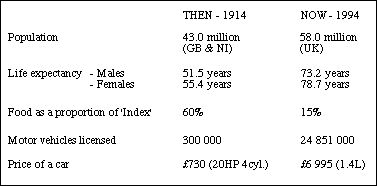
Fig 5.01 – A few statistics from the period 1914-1994,Published by CSO 26.04.1994
In the context of Figure 5.01 the CSO stated in 1994:
"As people become generally more prosperous and sophisticated, their needs change and so do their spending habits. In 1914 very few homes had electricity or gas, so candles were widely used for lighting and therefore featured in the cost of living index. Candles finally went out in 1956."
Changes in the products shown on the index list, reflected growing societal affluence. In 1914, food as a proportion of the index represented 60%; by 1994 it was only 15%. Such changes were only possible because of technology, including increased mechanisation in agriculture, and a wider choice of affordable products. The CSO goes on to state:
"The RPI is also a measure of purchasing power. For instance, since 1914 the pound has shrunk in value … to purchase what a pound could buy in 1914, you would now need to spend around £50."
So at the same level of technology, a car that cost £730 in 1914 would have cost £36,500 in 1994. How many could afford such prices? With improvements in product, manufacturing, and materials technologies, there was a car in 1994 available for £6995. The modern car was superior in performance, economy, ride, handling, cost of ownership, and was safer. These CSO data should similarly be a cause for celebration of the achievements of industry and technology, but there were no such references. The functions of industry and technology are simply not understood in our society.
Closing thoughts
As adults we know the importance of an income to set-up home, but as a society we have not yet succeeded in the effective transfer of this model to the national situation. To do so, requires serious engagement with our tool culture and technology culture, and to understand how knowledge builds on knowledge and underpins the creative processes through which technological change is achieved. Industry depends on a thriving culture of tools. Successful application of these processes creates jobs and wealth in the local socio-economic community. The income taxes and corporation taxes go to the exchequer; they help to pay for all the services we expect and demand from the state including health, education, transportation, law and order and many others.